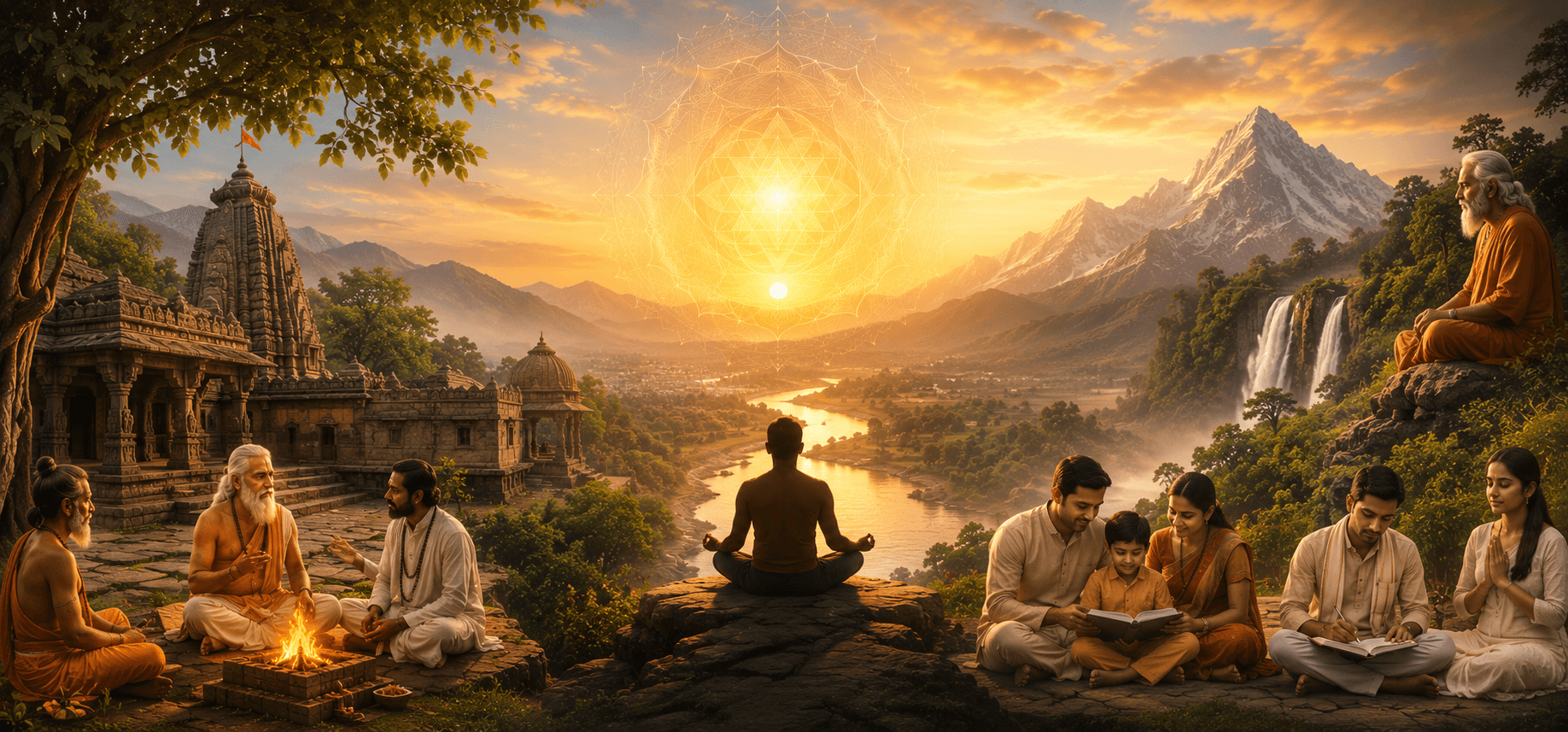
Excerpt: Sanatana Dharma means the “eternal way of living.” This beginner-friendly guide explains its meaning, history, scriptures, and core principles — and shows how truth, duty, compassion, and self-discipline can bring balance and inner peace to daily life.
Introduction: A Search for Meaning in Life
Arjun is twenty-six. He has a good job in a big city, a phone full of apps, and a calendar full of meetings. From the outside, his life looks fine. But at night, when the noise stops, a quiet question keeps returning: “Is this all? What am I really living for?”
He feels stressed at work, restless at home, and confused about what is right and wrong in daily choices. He wants discipline, but does not know where to begin. He wants peace, but does not know where to find it.
One evening, during a visit to his grandmother’s home, he watches her light a small lamp, sit quietly, and pray. She is calm in a way he is not. When he asks her about it, she smiles and says, “Beta, this is not just a ritual. This is a way of living. Our elders called it Sanatana Dharma.”
That one sentence starts Arjun’s journey — and it is a journey many people around the world are taking today. So what exactly is Sanatana Dharma? Is it a religion, a philosophy, or something more? Let us understand it step by step, in simple words.
What Is Sanatana Dharma?
The phrase comes from two Sanskrit words. Sanatana — eternal, timeless means that which has no clear beginning or end. Dharma — duty, truth, right way of living is harder to translate. It can mean duty, truth, natural order, righteousness, or simply “the right way to live.”
Put together, Sanatana Dharma means the eternal way of living — a set of timeless values and practices meant to guide human life in every age.
Today, the term is most often connected with the Hindu tradition. In fact, many Hindus prefer the name Sanatana Dharma for their tradition, because the word “Hinduism” came into common use much later, largely through outsiders describing the people and culture of the Indian subcontinent.
But the idea behind Sanatana Dharma is broader than any single label. It is a way of life built on values, responsibility, self-discipline, and spiritual growth. It asks a person not only “What do you believe?” but also “How do you live?”
Key idea: Sanatana Dharma is less about membership in a group and more about a lifelong practice of truth, duty, and inner growth.
Meaning of Sanatana Dharma in Simple Words
If you are a complete beginner, think of Sanatana Dharma as answering one question: “How should I live so that my life is good for me, good for others, and good for the world?”
Its answers show up in very ordinary, daily actions:
Being honest — speaking the truth even when it is not easy.
Doing your duty — as a student, parent, worker, or citizen, doing your part sincerely.
Respecting parents and elders — valuing the people who raised and guided you.
Living with compassion — being kind to people, animals, and all living beings.
Protecting nature — treating rivers, trees, and the earth with care, not greed.
Practising self-discipline — controlling anger, greed, and laziness a little more each day.
Notice that none of these depend on a particular building, festival, or community. They are universal human values. That is why Sanatana Dharma is often called “eternal” — these values were true thousands of years ago, and they are still true today.
Brief History of Sanatana Dharma
Sanatana Dharma has very ancient roots in the Indian subcontinent. It did not begin on one date, and it was not founded by one person. Instead, it grew slowly, like a great river fed by many streams, over thousands of years.
Its earliest known expressions are found in the Vedic tradition. The Vedas are among the oldest known collections of sacred texts in the world. For a very long time, this knowledge was passed on orally — teachers taught students by careful memorisation and recitation, generation after generation, before anything was written down.
Over long periods of time, many layers were added to this living tradition:
Rituals and prayers connected to nature, family, and community life.
Deep philosophical questions in the Upanishads about the self, the universe, and truth.
Practices of yoga and meditation for training the body and calming the mind.
Great story-based teachings like the Ramayana and the Mahabharata.
Devotional movements, local customs, temple traditions, art, music, and festivals.
Scholars still debate exact dates for many of these developments, so this article avoids claiming precise years. What is widely accepted is that Sanatana Dharma developed gradually over a very long period, absorbing new ideas while keeping its core values, and it continues as a living tradition followed by hundreds of millions of people today.
Important Scriptures and Knowledge Sources
Sanatana Dharma does not rest on a single book. It is supported by a large family of texts and traditions. Here are the main ones, explained simply:
The Vedas
The oldest foundation texts. They contain hymns, prayers, rituals, and early philosophical ideas. “Veda” itself means knowledge.
The Upanishads
Philosophical dialogues that ask deep questions: Who am I? What is the true self? What is the ultimate reality behind everything?
The Bhagavad Gita
A conversation between Lord Krishna and the warrior Arjuna. It teaches how to do one’s duty with a calm mind and without selfish attachment.
The Ramayana
The story of Lord Rama. It teaches ideals of duty, truthfulness, sacrifice, loyalty, and right conduct in family and society.
The Mahabharata
A vast epic about a family conflict, filled with lessons on dharma, choices, and their consequences. The Gita is a part of it.
The Puranas
Collections of stories about gods, sages, kings, and creation. They made deep ideas easy for ordinary people to understand.
Yoga Traditions
Practical systems for the body and mind — postures, breathing, concentration, and meditation — aimed at self-mastery and inner peace.
Living Culture
Family customs, festivals, folk wisdom, music, and local practices that carry values from one generation to the next.
Together, the Vedas and Upanishads give the philosophical roots, the epics give real-life examples, and daily practices bring the values into ordinary living.
Core Principles of Sanatana Dharma
Different teachers explain the principles in different ways, but a few core ideas appear again and again:
Dharma — duty and righteousness: doing what is right for your role in life, honestly and responsibly.
Karma — action and its result: every action has consequences. Good actions shape a better life and character; harmful actions bring suffering.
Ahimsa — non-violence: avoiding harm to any living being in thought, word, and action, as far as possible.
Satya — truthfulness: being honest with others and with yourself.
Seva — selfless service: helping others without expecting a reward.
Self-discipline: controlling desires, anger, and laziness through regular practice.
Respect for nature: seeing rivers, trees, animals, and the earth as worthy of care and gratitude.
Family values: honouring parents, caring for children and elders, and keeping the family strong.
Bhakti — devotion: loving connection with the Divine through prayer, song, and remembrance.
Meditation and the search for truth: quietening the mind to know one’s true self.
These principles work together. Truth without compassion can become harsh; devotion without duty can become empty. Sanatana Dharma asks for balance among all of them.
Why Sanatana Dharma Is Considered Powerful
Many people describe Sanatana Dharma as powerful. This does not mean it is “better” than other paths — every religion and culture deserves respect. Its strength lies in certain qualities:
Timeless values. Truth, duty, non-violence, and compassion never go out of date. They were useful in ancient villages and are just as useful in modern cities.
Adaptability. Sanatana Dharma has no single founder and no single rulebook, so it has been able to grow, absorb new ideas, and survive great changes across thousands of years while keeping its core alive.
Spiritual depth. The Upanishads and other texts ask some of the deepest questions humans have ever asked — about consciousness, the self, and reality — and offer many paths to explore them.
Practical tools. Yoga, breathing practices, and meditation came out of this tradition. Today, people all over the world use them for health, focus, and calm, whatever their personal beliefs.
Freedom of approach. It accepts that people are different. One person may grow through knowledge, another through devotion, another through service or meditation. Many paths, one goal.
Care for family and nature. It strengthens family bonds and treats the natural world as sacred, which feels especially relevant in an age of loneliness and environmental damage.
Sanatana Dharma as a Way of Living
Perhaps the most important point of this whole article is this: Sanatana Dharma is not something you only “believe.” It is something you do, a little every day.
In a traditional home, you can see this way of living clearly:
Food: meals are prepared with cleanliness and gratitude; many families prefer simple, sattvic (pure, light) food and avoid waste.
Thoughts: the day often begins with a prayer or a quiet moment, setting a calm and positive tone.
Actions: work is treated as a duty to be done well, not just a way to earn money.
Discipline: waking early, keeping routines, and practising moderation in eating, spending, and speaking.
Prayer and meditation: a few minutes of worship, chanting, or silence to reconnect with something higher.
Respect and gratitude: touching the feet of elders, thanking teachers, and honouring guests.
Service: feeding someone in need, helping neighbours, or caring for animals.
None of these acts is dramatic on its own. But repeated daily, they slowly shape a person’s character — which is exactly the point.
How Sanatana Dharma Helps in Modern Life
You may wonder: can such an old tradition really help with modern problems like stress, burnout, and confusion? Many people find that it can. Here is how its principles apply today:
Stress and anxiety. Meditation, breathing practices, and prayer calm the nervous system and quiet the racing mind. Even ten minutes a day makes a difference for many people.
Confusion in decisions. The idea of dharma gives a simple test: “Is this action truthful? Is it my duty? Does it harm anyone?” This cuts through many dilemmas at work and at home.
Work ethics. The Bhagavad Gita’s famous teaching — focus on doing your work well, without obsessing over rewards — is a healthy answer to today’s culture of comparison and burnout.
Family life. Respect for elders, patience with children, and shared rituals like eating or praying together strengthen bonds that modern schedules often weaken.
Discipline and patience. Daily routines of practice teach the mind to delay gratification — a skill that helps in studies, careers, health, and relationships.
Inner peace. Above all, Sanatana Dharma keeps reminding us that peace is found within, through self-knowledge and contentment, not only in achievements and possessions.
Sanatana Dharma and Nature
Long before “environmentalism” became a word, Sanatana Dharma taught people to treat nature as sacred.
Rivers like the Ganga are honoured as mothers. Trees such as the peepal and tulsi are cared for and even worshipped. The sun is greeted each morning with gratitude, because it gives life to everything. Cows and other animals are treated with kindness in many households. The earth itself is respectfully called Bhumi Devi — Mother Earth.
The message behind these practices is simple: humans are not the owners of nature, but a part of it. When we take from nature, we should also protect and give back. In a time of pollution and climate concerns, this ancient attitude of balance and gratitude feels more important than ever.
Common Misunderstandings About Sanatana Dharma
Because Sanatana Dharma is vast and diverse, it is often misunderstood. Let us clear a few common confusions, respectfully:
“It is only rituals.” Rituals exist, but they are tools, not the goal. Behind every ritual is a value — gratitude, discipline, remembrance, or community. Philosophy and self-inquiry are just as central.
“It is only about temples.” Temples are important centres of devotion and culture, but Sanatana Dharma lives equally in homes, in daily conduct, in how one treats a stranger or an animal.
“It is only festivals.” Festivals celebrate values like the victory of good over evil or gratitude for the harvest. They are joyful expressions of the tradition, not the whole of it.
“It is one fixed belief system.” In reality, it contains many schools of philosophy, many forms of worship, and much freedom of thought. Questioning and inquiry have always been welcomed — the Upanishads themselves are full of questions.
“It is against modern life.” Its core values — truth, duty, compassion, discipline — fit any era. Many scientists, professionals, and artists live by them while fully participating in the modern world.
Practical Lessons from Sanatana Dharma
If you want to bring the spirit of Sanatana Dharma into your life starting today, here are simple, practical lessons anyone can follow:
Live truthfully. Make honesty your default, in words and in work.
Do your duty first. Whatever your role — student, parent, employee — do it sincerely before demanding rights or rewards.
Control anger. Pause and breathe before reacting. Anger harms you first, then others.
Respect elders and teachers. Listen to their experience, even when you politely disagree.
Help someone daily. A small act of seva — food, time, kindness — purifies the heart.
Protect nature. Waste less, plant something, keep water and public places clean.
Keep learning. Read a little from the Gita or Upanishads, or listen to a good teacher, regularly.
Sit in silence. Give your mind ten quiet minutes a day — prayer, meditation, or simply watching the breath.
Practise contentment. Compare yourself less with others and more with who you were yesterday.
Be patient with yourself. Dharma is a lifelong practice, not a weekend course.
Conclusion
Let us return to Arjun. He did not change his job or his city. He changed how he lived. He began waking a little earlier, sitting quietly for a few minutes, doing his work as a duty rather than a burden, speaking more truthfully, calling his parents more often, and helping where he could. Slowly, the restless question — “Is this all?” — grew quieter. Life felt fuller, not because he added more to it, but because he lived it with more meaning.
That is the heart of this teaching. Sanatana Dharma is not only about belief — it is about living with truth, duty, discipline, compassion, and spiritual awareness. It is called eternal because these values never expire. Whoever you are, and wherever you live, you can begin today, with one honest word, one sincere duty, one kind act, and one quiet moment.
Final takeaway: Sanatana Dharma is the eternal way of living well — start small, live truthfully, do your duty, care for others and for nature, and keep growing inward.
FAQs About Sanatana Dharma
1. What is Sanatana Dharma in simple words?
Sanatana Dharma means the “eternal way of living.” It is a timeless set of values and practices — truth, duty, compassion, self-discipline, and spiritual growth — that guide a person to live well, most closely associated with the Hindu tradition.
2. What does Sanatana Dharma mean?
“Sanatana” is a Sanskrit word meaning eternal or timeless. “Dharma” means duty, truth, natural order, or the right way of living. Together, they mean the eternal law or eternal way of righteous living.
3. Is Sanatana Dharma the same as Hinduism?
They are closely related. Many Hindus use Sanatana Dharma as the traditional name for their faith, since “Hinduism” is a more recent term that came into common use through outsiders describing Indian culture. At the same time, Sanatana Dharma also points to universal values — truth, duty, compassion — that anyone can appreciate and practise.
4. What is the history of Sanatana Dharma?
It has ancient roots in the Indian subcontinent, beginning with the Vedic tradition, whose knowledge was passed down orally for generations. Over a very long period, it grew through the Upanishads, the epics, yoga and meditation traditions, devotional movements, and local cultural practices. It has no single founder and no single starting date.
5. Why is Sanatana Dharma important?
It offers timeless guidance for living: how to act rightly, treat others kindly, discipline the mind, care for nature, and find inner peace. Its practices, such as yoga and meditation, benefit people all over the world today.
6. What are the main principles of Sanatana Dharma?
Key principles include dharma (duty and righteousness), karma (actions and their results), ahimsa (non-violence), satya (truthfulness), seva (selfless service), self-discipline, devotion, respect for family and nature, and the search for truth through meditation and self-knowledge.
7. How does Sanatana Dharma help in daily life?
Its principles reduce stress through meditation and prayer, guide decisions through the test of dharma, improve work ethics by focusing on duty rather than only rewards, strengthen family bonds, and build patience, discipline, and inner peace.
8. Which scriptures are connected with Sanatana Dharma?
The main sources are the Vedas, the Upanishads, the Bhagavad Gita, the Ramayana, the Mahabharata, and the Puranas, along with yoga texts and living cultural traditions passed through families and communities.
9. Why is Sanatana Dharma called a way of life?
Because it is practised through daily living — honest speech, sincere work, respect for elders, kindness to all beings, care for nature, prayer, and meditation — rather than through belief alone. It shapes how a person eats, thinks, works, and treats others every day.
10. Does this article need live fact-checking?
Historical and scriptural explanations should be checked with reliable sources before publishing. Any current legal, political, or social claim needs live verification.
0 comments