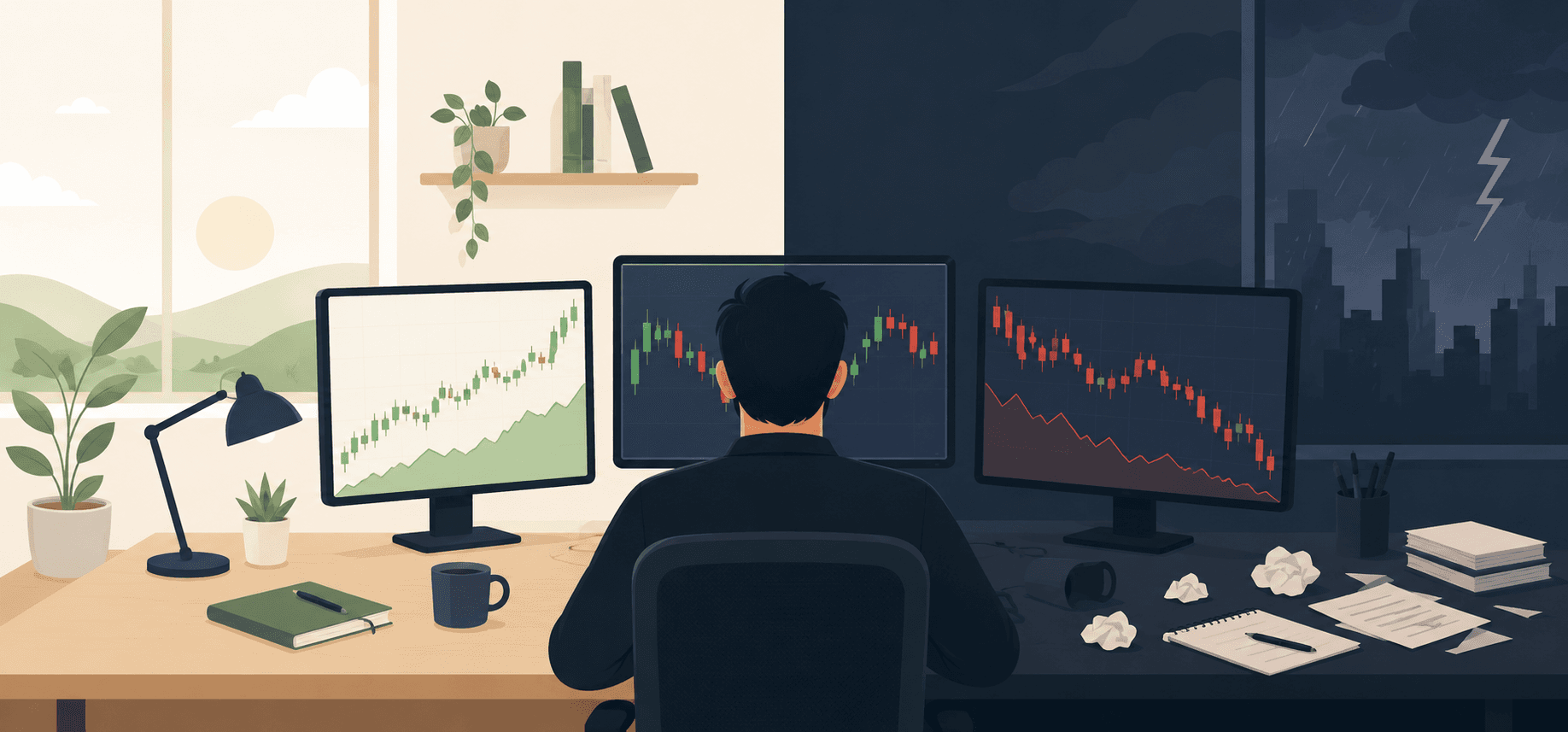
very few months the same question lands in thousands of search bars at 1 a.m.: "Can I take trading as a career?" Usually it arrives after a long day at a job that feels like a slow leak, paired with a video of a stranger in a rented car promising you the same freedom. The honest answer is not a clean yes or no. It is a decision tree — and this guide walks you down both branches, with real numbers, real risks, and a real plan for whichever path is actually yours.
We are going to treat this seriously, because it is serious. Choosing day trading as a full-time career is one of the highest-variance career bets a person can make. Done with discipline, capital, and a tested edge, it can become a genuine profession. Done on hope and adrenaline, it quietly drains savings that took years to build. The goal here is not to talk you into it or out of it — it is to make sure that when you decide, you are the most informed person in the room.
Trading rewards the patient and punishes the desperate. The same market that funds one person's freedom funds another person's lesson.— A principle every serious desk repeats in some form
01 What "Trading as a Career" Actually Means
Before answering whether you can, it helps to define what you would actually be signing up for, because "trading" hides several very different jobs under one word. The version most people picture — sitting at home, watching charts, buying and selling within the same day for a living — is specifically day trading, and it is the most demanding flavour of all.
The spectrum of "trading"
Treating these as the same career is the first mistake beginners make. They differ in time commitment, capital needs, stress, and odds of survival.
How different trading styles compare as a potential career
Style | Holding Period | Time Demand | Stress Level | Career Difficulty |
|---|---|---|---|---|
Day trading | Seconds to one day | Full-time, screen-bound | Very high | Hardest |
Scalping | Seconds to minutes | Intense, continuous | Extreme | Hardest |
Swing trading | Days to weeks | Part-time possible | Moderate | Hard |
Position trading | Weeks to months | Low | Lower | Moderate |
Long-term investing | Years | Very low | Low | Most sustainable |
This article centres on day trading because that is what most people mean when they romanticise "becoming a trader." But notice something important: the further down that table you go, the higher your odds of long-term success and the lower the personal toll. We will return to this, because it shapes both the "yes" and the "no."
Two doors: trading for a firm vs. trading for yourself
There is also a fork inside the fork. You can trade institutionally — for a bank, hedge fund, or proprietary trading firm, with their capital, their risk limits, a salary, and a team around you. Or you can trade retail — your own money, your own account, alone. The institutional path is a real, respected career with a salary floor; the retail path has no floor at all. Most people asking this question mean the retail version, which is exactly why honesty matters so much.
02 The Honest Numbers: What the Data Really Says
Any guide that skips the survival statistics is selling you something. So let's lead with them. Across multiple academic studies and regulator reviews from different countries, the pattern is remarkably consistent: the large majority of retail day traders lose money over time, and only a small, persistent minority remain profitable across years.
~70–90%
of active retail traders are commonly found to lose money over time across multiple studies
1–3 yrs
typical learning curve before consistency, for those who reach it at all
$25,000
minimum US margin balance under the Pattern Day Trader rule
<1%
rough share who consistently outperform after costs, in stricter studies
These ranges vary by market, period, and methodology, so treat them as direction rather than precision. But the direction never reverses: trading is a field where most participants do not win, and the winners win because of process, not luck. That is not a reason to quit before you start. It is the single most important fact to internalise before you risk a cent — because it reframes the question from "how do I get rich?" to "how do I survive long enough to get good?"
Reality Check Survivorship bias is everywhere
The traders you see online are, by definition, the ones still trading. The far larger group who blew up their accounts and quit don't post recap videos. When you scroll through "lifestyle" trading content, you are looking at a heavily filtered sample. Calibrate accordingly.
03 What If the Answer Is YES — The Case For It
Now the encouraging branch, because for a specific kind of person, trading genuinely can be a career — and an extraordinary one. If you are wired for it and willing to do the unglamorous work, here is what the "yes" actually offers.
The real benefits, stated plainly
Uncapped, performance-linked income. Unlike a salary, your earnings are not bounded by a title or a manager's budget. A strong year can pay multiples of a corporate job. This is the magnet, and it is real — for the few who survive to enjoy it.
Autonomy and location freedom. No commute, no office politics, no permission needed to take a Tuesday off. You answer to the market, not a boss. For independent-minded people, this is worth more than money.
A pure meritocracy. The market does not care about your degree, accent, age, or network. Your P&L is the only review you get. Few fields are this blind to background.
Compounding skill. Risk management, probability thinking, and emotional discipline are transferable assets. Even if you stop trading, those skills upgrade every other financial decision you make for life.
Scalability. A working strategy applied to $10,000 can often be applied to $100,000 with similar effort. Few careers let you scale output without scaling hours.
Who actually tends to make it
The successful traders we'd describe share less in common with gamblers and more in common with disciplined business operators. They tend to be patient under boredom, ruthless about cutting losses, comfortable being wrong often, and obsessive about reviewing their own decisions. They treat a string of small losses as a cost of doing business, not a personal failure. If that description energises you rather than exhausts you, the "yes" branch is at least worth exploring carefully.
Insider Tip Profitability is a by-product of survival
Beginners chase winning trades. Professionals chase not losing the account. Protect your capital relentlessly and the profits get a chance to arrive. Blow up once and the game is over before your edge ever showed up.
04 What If the Answer Is NO — And Why "No" Can Be the Smart Choice
Here is the part most "become a trader" content refuses to say: for the majority of people, "no" is the financially intelligent answer — and choosing it is a sign of clarity, not weakness. There is no shame in deciding that the variance, isolation, and capital risk are not worth it for your life and your responsibilities.
Legitimate reasons to say no (or "not now")
You can't afford to lose your starting capital. If the money you'd trade is rent, tuition, or a safety net, the answer is simply no. Trading capital must be money you can genuinely afford to lose entirely.
You need income stability. Dependents, a mortgage, or a low risk tolerance make irregular, sometimes-negative monthly income a poor fit. Stress bleeds into everything.
Your temperament fights it. If losses keep you up at night or you struggle to follow your own rules under pressure, the market will extract that weakness expensively.
The opportunity cost is high. The years and energy spent learning to trade could compound a career, a business, or long-term investments with far better odds.
"No" doesn't mean walking away from markets
Crucially, declining a full-time day trading career is not the same as ignoring the markets. Some of the most financially secure people never day trade at all. They simply invest consistently, let time and compounding do the heavy lifting, and keep a stable income they enjoy. Saying no to the screen-bound career while saying yes to disciplined long-term investing is, for most people, the higher-return decision over a lifetime.
The decision is not "trading vs. nothing." It is "high-stress, high-variance trading vs. a dozen calmer paths to the same financial goal."
05 A Side-by-Side: The Yes vs. No Decision
Sometimes the clearest way to decide is to see both columns at once. Read each row and notice which side your gut leans toward — that pattern is often more honest than any single answer.
The trading career trade-off, branch by branch
Factor | If YES (full-time trading) | If NO (alternative path) |
|---|---|---|
Income | Uncapped but volatile, often negative early | Stable, predictable, slower to scale |
Risk | You can lose your capital entirely | Diversified, lower personal downside |
Freedom | High autonomy, location independence | Structured, less flexible |
Stress | Very high, constant decision-making | Lower, more sustainable |
Odds of success | Low for retail; minority survive | High; steady careers usually pay off |
Skill transfer | Valuable risk/data skills | Depends on chosen field |
Best for | Disciplined, capitalised risk-takers | Most people, most of the time |
06 If You Choose Yes: A Step-by-Step Starting Plan
Say you've weighed it honestly and the "yes" still pulls at you. Good — then do it the way professionals do, not the way the highlight reels suggest. Here is a sane, survivable on-ramp.
Step 1 — Keep your day job (for now)
Almost no successful full-time trader started full-time. Learn while you earn. A stable income removes the desperation that destroys decision-making, and it funds your education without touching your trading capital.
Step 2 — Educate before you risk
Learn market mechanics, order types, technical and fundamental basics, and above all risk management. Read widely, but be allergic to any "course" promising guaranteed returns. Free, reputable material from exchanges and regulators beats most paid "guru" programs.
Step 3 — Paper trade, then trade tiny
Use a demo account to test strategies without money, then graduate to real but small positions. The psychological gap between paper and real money is enormous — bridge it gradually.
Step 4 — Build and back-test a written strategy
An "edge" is a repeatable setup with a positive expected value after costs. Define entries, exits, and position sizing in writing. If you can't explain your edge in two sentences, you don't have one yet.
Step 5 — Keep a brutal trading journal
Record every trade: the setup, the reasoning, the outcome, and your emotional state. Your journal is the single fastest way to find and fix the leaks in your process. Most traders skip this. Don't be most traders.
Step 6 — Define your "go full-time" threshold in advance
Decide now, in calm conditions, what proof you'll require before quitting your job — for example, multiple consecutive profitable quarters that comfortably exceed your living expenses, plus a separate emergency fund. Then hold yourself to it.
Risk Rule The 1% guideline
A widely used discipline is risking no more than 1% of your account on any single trade. It feels slow. That's the point — it's what keeps a losing streak from becoming a career-ending event.
07 If You Choose No: Careers That Use the Same Skills
Maybe the honest answer is no — but the fascination with markets and money is real. Excellent news: that interest maps onto a whole field of stable, well-paid careers that use the same muscles without betting your livelihood on a single account.
Quantitative analyst / data analyst: Build the models the market runs on, with a salary and a team.
Financial planner / advisor: Help others invest wisely; relationship-driven and durable.
Risk manager: Companies pay well for people who deeply understand downside — exactly the skill trading teaches.
Fintech product or operations: The industry building the future of money needs people who understand it.
Equity research / investment analysis: Deep market knowledge applied with stability and structure.
Part-time / swing trading on the side: Keep the upside, lose the all-or-nothing pressure.
Each of these is, arguably, more future-proof than solo retail day trading, because they combine market literacy with the stability and team leverage that compound a career over decades.
08 Is Trading a Future-Proof Career in the AI Era?
Since this guide is written for the long game, we have to address the elephant in the server room: automation and AI. Algorithms already execute the majority of volume in many markets, and AI tools are spreading fast to retail. Does that kill the trading career?
Not exactly — but it changes it. The repetitive, speed-based edges that once made simple day trading profitable are increasingly competed away by machines that never blink. What survives is adaptable human judgement: understanding regime changes, managing risk through chaos, and pairing intuition with tools rather than against them. The future-proof version of a trading career treats trading as a transferable skill set in risk, data, and decision-making — not a single static strategy to ride forever.
The traders who last won't be the ones racing the machines. They'll be the ones who learned to use the machines — and kept the human edge the machines still lack.
⚡ Actionable Takeaways
Internalise the odds first. Most retail day traders lose money. Plan to survive, not to get rich quick.
Never trade money you can't afford to lose. Keep living expenses and an emergency fund completely separate.
Start part-time, keep your income, and only go full-time against a pre-defined proof of consistency.
Master risk management before strategy. The 1% rule and a written plan keep you in the game.
Journal every trade. Your edge is found in your own data, not someone else's video.
"No" is a valid, often smarter answer — and adjacent careers offer the same upside with far better odds.
Stay adaptable. In an AI-driven market, flexible judgement beats any fixed strategy.
09 Frequently Asked Questions
10 Final Thoughts: Choose the Branch That Fits Your Life
So — can you take trading as a career? Yes, you can. But "can" is the wrong question. The better questions are: Should you? Right now? With this capital, this temperament, and these responsibilities? Answer those honestly and the path usually reveals itself.
If the answer is yes, earn the right to go full-time slowly — with education, tiny positions, a written edge, a brutal journal, and a hard rule never to risk what you can't lose. If the answer is no, hold your head high: you've made the statistically smarter choice, and a dozen calmer paths to wealth remain wide open, including simply investing well over time.
Either way, the worst decision is the unexamined one — quitting a stable life on a screenshot, or dismissing a real opportunity out of fear. You're clearly already thinking it through. That instinct, more than any strategy, is what will protect your money and your future.

0 comments