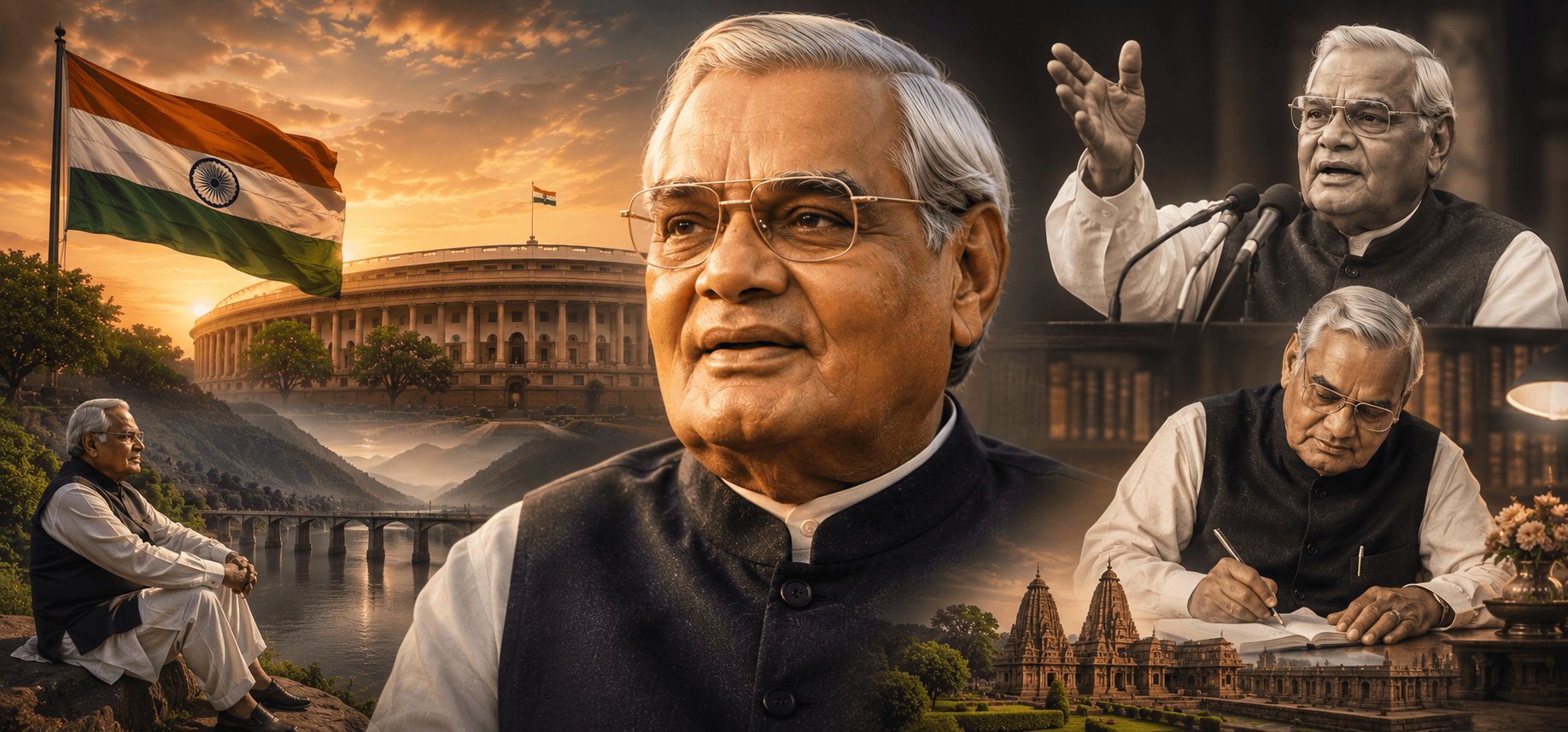
Excerpt: A simple, complete, and balanced biography of Atal Bihari Vajpayee — former Prime Minister of India, celebrated speaker, poet, and one of the most respected leaders in Indian political history.
Introduction: A Leader Remembered for Words, Wisdom, and Vision
Some leaders are remembered for the power they held. A few are remembered for the way they made people feel. Atal Bihari Vajpayee belonged to the second group. When he stood up to speak in Parliament, members from every party listened. When he paused in the middle of a sentence — a habit that became famous — the whole hall waited for his next word.
This Atal Bihari Vajpayee biography tells the story of a schoolteacher's son from Gwalior who became the former Prime Minister of India three times. He was a politician, a parliamentarian for over four decades, a poet, a journalist, and one of the finest public speakers India has produced. His rivals disagreed with his politics, but very few disliked him as a person. That rare respect across party lines is the first thing to understand about his life.
In this article, we look at his early life, education, long political career, achievements as Prime Minister, economic and infrastructure vision, diplomacy, awards, and lasting legacy — all in simple language that students and general readers can easily follow.
Quick Facts About Atal Bihari Vajpayee
Full Name | Atal Bihari Vajpayee |
|---|---|
Date of Birth | 25 December 1924 |
Place of Birth | Gwalior, Madhya Pradesh (then part of Gwalior State, British India) |
Education | BA from Victoria College, Gwalior; MA in Political Science from DAV College, Kanpur |
Profession | Politician, Parliamentarian, Writer, Poet |
Major Role | Former Prime Minister of India (1996; 1998–1999; 1999–2004) |
Political Party | Bharatiya Jana Sangh (founding member); Janata Party; Bharatiya Janata Party (founding president) |
Major Award | Bharat Ratna (2015); Padma Vibhushan (1992) |
Date of Death | 16 August 2018, New Delhi |
Early Life and Family Background
Atal Bihari Vajpayee was born on 25 December 1924 in Gwalior, in a middle-class Brahmin family. His father, Krishna Bihari Vajpayee, was a schoolteacher and also a poet who wrote in Hindi and Braj. His mother, Krishna Devi, managed the home. The family's roots were in Bateshwar, a village in the Agra district of Uttar Pradesh, from where his grandfather had moved to Gwalior.
Growing up in a teacher's home shaped young Atal in two ways. First, education was treated as the most valuable thing a family could give a child. Second, poetry and language were part of daily life, because his father loved to recite and compose verses. Many people believe Vajpayee's famous gift for words began at his own dining table.
The family was not wealthy, but it was disciplined and rooted in simple values — honesty, hard work, and respect for learning. These values stayed with Vajpayee throughout his public life. He never married and often described the nation and public service as his life's main commitment.
Education Background
Vajpayee's early schooling took place in Gwalior. He then studied at Victoria College in Gwalior (today known as Maharani Laxmi Bai Government College of Excellence), where he completed his Bachelor of Arts with subjects including Hindi, English, and Sanskrit. He was known as a bright student and an eager participant in debates.
For higher studies, he moved to DAV College in Kanpur, Uttar Pradesh, where he earned a Master of Arts degree in Political Science with a first-class result. Studying political science gave him a strong understanding of how governments, constitutions, and democracies work — knowledge he would later use every day in Parliament.
Interestingly, for a short time he also began studying law in Kanpur, reportedly attending classes alongside his own father, who had joined the same course. However, Vajpayee soon left formal studies to devote himself fully to social and political work. His real classroom, from then on, became public life itself.
Interest in Literature, Poetry, and Public Speaking
Long before he became a politician, Vajpayee was a lover of words. He wrote Hindi poetry from a young age, inspired by his father. His poems usually spoke about hope, struggle, courage in difficult times, the beauty of the motherland, and the ups and downs of life. Later in life, his poetry collections, such as Meri Ekyavan Kavitayen (My Fifty-One Poems), became popular with ordinary readers. In line with copyright rules, we summarise the spirit of his poems here rather than reproducing them: their central message was that a person should never accept defeat and should keep walking forward, whatever the situation.
He also worked as a journalist in his early years. He edited Hindi publications connected to the nationalist movement of ideas, including the monthly Rashtradharma, the weekly Panchjanya, and the newspapers Swadesh and Veer Arjun. Journalism taught him how to explain complex ideas in simple words — a skill that later made his speeches easy for everyone to understand.
His public speaking style became legendary. He used short sentences, long meaningful pauses, gentle humour, and poetic phrases. Even people who opposed his party admitted that listening to Vajpayee was an experience in itself.
Entry Into Public Life
Vajpayee's journey into public life began in his student days. As a teenager in Gwalior, he took part in debates and student activities. In 1939, he came into contact with the Rashtriya Swayamsevak Sangh (RSS), a Hindu nationalist volunteer organisation, and became a regular member. In 1942, during the Quit India Movement against British rule, he and his elder brother were briefly detained in Bateshwar — an early brush with the freedom struggle.
In 1947, the year India became independent, Vajpayee became a full-time worker (called a pracharak) of the RSS. He gave up thoughts of a legal career and moved into organisational and journalistic work. Through his writing and speaking, he quickly became known in nationalist circles as a talented young communicator.
This mix of student activism, journalism, and organisational work formed the foundation of his political life. He entered politics not through family connections or wealth, but through ideas, language, and tireless work — a point often highlighted in any Atal Bihari Vajpayee life history.
Political Background and Early Political Career
Vajpayee's formal political career began in 1951, when he became a founding member of the Bharatiya Jana Sangh, a new political party started by Dr. Syama Prasad Mookerjee. Vajpayee worked closely with Mookerjee as a young aide and secretary, travelling with him and learning politics from the ground up. Mookerjee's death in 1953, while in detention in Kashmir, deeply affected Vajpayee and strengthened his commitment to the party.
He contested Lok Sabha elections in 1955 without success, but in 1957 he won from the Balrampur constituency in Uttar Pradesh and entered the Lok Sabha, the lower house of India's Parliament, for the first time. He was in his early thirties.
His very first speeches in Parliament attracted attention. His command over Hindi, his logical arguments, and his respectful tone impressed even senior leaders of the ruling Congress party. It is widely recorded that Prime Minister Jawaharlal Nehru praised the young parliamentarian and saw a bright future for him. From these early years, Vajpayee built a reputation that would define his entire Atal Bihari Vajpayee political career: firm in ideas, but gentle in manner.
Role in Bharatiya Jana Sangh
For nearly three decades, Vajpayee was one of the central figures of the Bharatiya Jana Sangh. After the sudden death of party ideologue Deendayal Upadhyaya in 1968, Vajpayee became the national president of the Jana Sangh. Under his leadership, the party worked to grow beyond its limited base and speak on national issues such as the economy, defence, and foreign policy.
Inside Parliament, Vajpayee became the voice of the opposition on many major debates. He questioned government policies strongly, but always within democratic limits and with personal courtesy. This made him respected across the political divide, which was unusual for an opposition leader of a small party.
During the Emergency (1975–1977), when the government of Prime Minister Indira Gandhi suspended many democratic rights, Vajpayee was among the thousands of opposition leaders who were arrested and jailed. His time in detention became an important chapter in his political life and strengthened his image as a defender of democracy.
Role During the Janata Party Period
After the Emergency ended, several opposition parties, including the Jana Sangh, merged to form the Janata Party. In the 1977 general elections, the Janata Party defeated the Congress and formed the first non-Congress government in independent India, led by Prime Minister Morarji Desai.
In this government, Vajpayee served as the Minister of External Affairs (foreign minister) from 1977 to 1979. It was his first experience of running a major ministry, and he handled it with maturity. He worked to improve relations with neighbouring countries, including Pakistan and China, and presented India's views confidently on the world stage.
A moment from this period is still remembered with pride: in 1977, Vajpayee delivered a speech at the United Nations General Assembly in Hindi — the first time India's voice was heard in Hindi at that global platform. For him, it was a matter of honour to speak in an Indian language before the world.
The Janata government, however, collapsed in 1979 due to internal differences. This failure taught Vajpayee hard lessons about coalition politics — lessons he would use skilfully two decades later as Prime Minister.
Role in the Bharatiya Janata Party
In 1980, after the break-up of the Janata Party experiment, former Jana Sangh members founded a new party: the Bharatiya Janata Party (BJP). Atal Bihari Vajpayee became its first national president. Along with close colleagues such as Lal Krishna Advani, he shaped the new party's identity, giving it the guiding idea of "Gandhian socialism" in its early years and stressing integral humanism, nationalism, and good governance.
The beginning was painful. In the 1984 general elections, held soon after the assassination of Prime Minister Indira Gandhi, the BJP won only two seats in the Lok Sabha. Many wrote the party off. Vajpayee, however, kept working patiently, touring the country and rebuilding the organisation.
Through the late 1980s and 1990s, the BJP grew rapidly and became one of India's two main national parties. Within this rise, Vajpayee played a special role: he was the party's most acceptable face for allies and undecided voters. His moderate image, clean reputation, and cross-party goodwill made it possible for many regional parties to join hands with the BJP — something that directly led to his prime ministership.
Parliamentary Career
Vajpayee's parliamentary career is one of the longest and most celebrated in Indian history. He was elected to the Lok Sabha ten times, starting in 1957, and also served two terms in the Rajya Sabha, the upper house. Over the decades, he represented constituencies in different states, including Balrampur, Gwalior, New Delhi, and finally Lucknow, which he represented continuously from 1991 until his retirement in 2009.
In Parliament, he was admired for three qualities: his deep respect for democratic institutions, his brilliant debating skill, and his ability to disagree without being disagreeable. He believed that governments and oppositions may fight over policies, but the dignity of Parliament must always be protected.
His stature as a parliamentarian was formally recognised when he received the Best Parliamentarian Award in 1994, an honour supported by members across party lines. For students of political science, his career remains a model of how parliamentary democracy is meant to work.
Atal Bihari Vajpayee as Prime Minister of India
Vajpayee served as the Prime Minister of India three times, and each term tells a different story.
First term (1996): After the 1996 general elections, the BJP emerged as the single largest party, and Vajpayee was invited to form the government. However, he could not gather majority support in the Lok Sabha, and his government lasted only 13 days. Instead of clinging to power, he resigned with a dignified speech in Parliament that is still remembered for its grace and democratic spirit.
Second term (1998–1999): In 1998, Vajpayee returned as Prime Minister at the head of a large coalition of parties called the National Democratic Alliance (NDA). This government took the historic decision to conduct nuclear tests at Pokhran in May 1998. The government fell in April 1999 after losing a confidence vote by just one vote — one of the closest moments in Indian parliamentary history.
Third term (1999–2004): After the NDA's victory in the 1999 elections, held in the shadow of the Kargil conflict, Vajpayee became Prime Minister again. This time, his coalition government completed a full five-year term — making him the first non-Congress Prime Minister of India to do so. This term saw major work on highways, telecom, education, and the economy, along with serious challenges such as the 2001 Parliament attack and the 2002 Gujarat riots.
Across all three terms, his governance style was consultative. He managed a coalition of over twenty parties by listening patiently, sharing credit, and keeping communication open — a skill many consider his greatest political achievement.
Major Achievements of Atal Bihari Vajpayee
The list of Atal Bihari Vajpayee achievements covers many fields. The most important ones include:
Nuclear tests (1998): Under his leadership, India conducted the Pokhran-II nuclear tests and declared itself a nuclear weapons state, while committing to a policy of "no first use".
Golden Quadrilateral: He launched India's largest-ever highway project, connecting Delhi, Mumbai, Chennai, and Kolkata with modern four-lane roads.
Pradhan Mantri Gram Sadak Yojana (2000): A national programme to connect villages with all-weather roads, transforming rural life.
Sarva Shiksha Abhiyan (2001): A nationwide mission to bring every child into school, followed by the 86th Constitutional Amendment (2002), which made free education for children aged 6 to 14 a fundamental right.
Telecom revolution: The New Telecom Policy of 1999 changed licensing rules and helped mobile phones become affordable for common Indians.
Economic reforms: His government pushed disinvestment of loss-making public companies, fiscal discipline through the FRBM Act (2003), and steady economic growth.
Peace efforts with Pakistan: The Lahore bus journey (1999) and later dialogue efforts showed courage in seeking peace, even after setbacks.
Creation of three new states (2000): Chhattisgarh, Uttarakhand (then Uttaranchal), and Jharkhand were formed peacefully to improve governance.
Economic Vision
Vajpayee's economic thinking was practical rather than ideological. He believed that India's economic reforms, which began in 1991, should continue and go deeper, but always with attention to the poor and to rural India. His government's approach can be summed up in a simple idea: growth builds strength, and strength builds welfare.
His government reduced government control over several industries, opened more sectors to private and foreign investment, and created a separate ministry to handle the sale of loss-making public sector companies. It also passed the Fiscal Responsibility and Budget Management (FRBM) Act in 2003, which required governments to control their deficits — an important step towards financial discipline.
During his full term, India's economy grew at a healthy pace, foreign exchange reserves rose strongly, inflation remained moderate, and India began to be seen globally as a rising economic power. Many economists view his years in office as a bridge that carried the 1991 reforms into the high-growth era that followed.
Infrastructure Vision
If one word captures Vajpayee's development philosophy, it is connectivity. He believed that roads, telephones, and power lines were not luxuries but the basic tools of progress, and that a connected India would automatically become a faster-growing India.
His signature project was the National Highways Development Project, whose first phase — the Golden Quadrilateral — aimed to link India's four biggest metropolitan cities with world-class highways. Alongside it, the North–South and East–West corridors were planned to connect the far ends of the country.
Equally important was the Pradhan Mantri Gram Sadak Yojana, launched in December 2000, which set out to give every sizeable village an all-weather road. For millions of rural families, this scheme meant easier access to markets, hospitals, and schools. Together, these programmes are considered the largest road-building effort in India since ancient times, and they remain central to his legacy.
Foreign Policy and Diplomacy
Atal Bihari Vajpayee diplomacy rested on a simple belief he often expressed: you can change friends, but you cannot change neighbours. For him, this meant India must be strong enough to defend itself, yet always willing to talk peace.
With Pakistan, he made repeated, sincere efforts for peace. In February 1999, he travelled to Lahore by bus and signed the Lahore Declaration with Prime Minister Nawaz Sharif, promising dialogue and restraint. Even after the Kargil conflict and the failed Agra Summit of 2001, he restarted the peace process in 2003–2004, believing that talks must continue despite betrayals.
With the United States, he transformed a distant relationship into a warm partnership. After initial sanctions following the 1998 nuclear tests, sustained dialogue led to President Bill Clinton's landmark visit to India in 2000 and Vajpayee's own visits to the US, opening a new era of India–US cooperation. He famously described India and the US as "natural allies".
With China, his 2003 visit helped set up a special mechanism to discuss the boundary question, keeping the relationship stable. He also strengthened ties with Russia, Israel, the ASEAN countries, and Europe. Under him, India's foreign policy became more confident and more widely respected.
International Visits and Global Engagement
Vajpayee's global engagement began early. As foreign minister in the late 1970s, he travelled widely and addressed the United Nations General Assembly in Hindi in 1977. As Prime Minister, his important verified international engagements include:
Lahore, Pakistan (February 1999): The historic bus journey and the Lahore Declaration with Prime Minister Nawaz Sharif.
United Nations, New York: Multiple addresses to the UN General Assembly as Prime Minister, presenting India's views on terrorism, development, and peace.
United States (2000 and later): A landmark visit including an address to a joint session of the US Congress, deepening India–US relations after President Clinton's visit to India.
China (June 2003): A visit that led to the appointment of Special Representatives to discuss the India–China boundary question.
SAARC Summit, Islamabad (January 2004): A visit to Pakistan that helped restart the composite dialogue between the two countries.
These visits shared one theme: India would engage the world with self-respect, seeking cooperation without compromising its core interests. Exact dates of individual meetings should be verified live before academic use, but the events listed above are well documented.
National Security and Nuclear Policy
The boldest decision of Vajpayee's career came in May 1998, within weeks of becoming Prime Minister for the second time. On 11 and 13 May 1998, India conducted five nuclear tests at Pokhran in Rajasthan, known as Pokhran-II or Operation Shakti. With these tests, India openly declared itself a nuclear weapons state.
The world reacted sharply. Several countries, including the United States, imposed economic sanctions. Vajpayee's government handled the pressure calmly, explaining that India's nuclear capability was for self-defence in a difficult neighbourhood. India announced a doctrine of credible minimum deterrence and a clear "no first use" policy — meaning India would never use nuclear weapons first against any country.
In 1999, his government also faced the Kargil conflict, when Pakistani soldiers and infiltrators occupied heights on the Indian side of the Line of Control in Jammu and Kashmir. Vajpayee ordered the armed forces to evict the intruders but instructed them not to cross the Line of Control, keeping the conflict limited. India's victory in Kargil, achieved with restraint, won international understanding and respect. His approach showed his balance: strength without aggression, and peace without weakness.
Innovations, Reforms, and Governance Style
Beyond the headline achievements, Vajpayee's government introduced several quiet but lasting reforms:
Telecom reform: The New Telecom Policy (1999) shifted operators from heavy fixed licence fees to revenue sharing, which cut call costs and triggered India's mobile phone boom.
Information technology: His government actively promoted the IT and software industry, helping India become a global technology services hub.
Education reform: Sarva Shiksha Abhiyan and the constitutional right to education changed how India approached schooling for every child.
Fiscal reform: The FRBM Act (2003) created legal limits on government borrowing.
Administrative reform: New states were created for better governance, and interlinking of rivers and other long-term ideas were studied seriously.
His governance style was patient and consensus-driven. He gave his ministers freedom to work, took criticism without bitterness, and preferred persuasion over pressure. Colleagues across parties described him as a leader who could hold a large, noisy coalition together simply through trust.
Leadership Style and Vision for India
The Atal Bihari Vajpayee vision for India can be described in five simple ideas:
Democracy first: Power is temporary; institutions are permanent. He resigned gracefully in 1996 and accepted defeat gracefully in 2004, teaching by example.
Development for all: Roads, schools, and telephones for every Indian, not only for cities.
Strength with responsibility: A strong defence, including nuclear capability, used only for protection, never for threat.
Dialogue over conflict: Talk to opponents at home and rivals abroad; keep every door open.
Unity in diversity: He often reminded people that India belongs to all its citizens, whatever their religion, language, or region.
As a leader, he combined firmness on goals with flexibility on methods. He rarely raised his voice, used humour to cool tempers, and treated even his sharpest critics with courtesy. Political scientists often cite him as an example of "consensual leadership" in a diverse democracy.
Challenges in His Political Journey
Vajpayee's path was never easy, and an honest biography must record his challenges as well:
Decades in opposition: For most of his career, his party was small, and electoral defeats were frequent. The BJP's two-seat result in 1984 was a low point he had to rebuild from.
Coalition pressures: Running a government of more than twenty parties meant constant negotiation, compromises on policy, and threats of withdrawal by allies. His 1999 government fell by a single vote.
Security crises: The Kargil conflict (1999), the hijacking of Indian Airlines flight IC-814 to Kandahar (December 1999), and the terrorist attack on Parliament (December 2001) tested his government severely. The Kandahar episode, in which prisoners were released to save passengers, drew criticism and remained a painful decision.
The 2002 Gujarat riots: The communal violence in Gujarat was a grave national tragedy and became one of the most debated chapters of his tenure, drawing criticism of both the state and central handling of the situation.
Electoral defeat in 2004: Despite the confident "India Shining" campaign, the NDA lost the 2004 elections, showing how unpredictable democracy can be.
Through all these challenges, his responses stayed within democratic limits, and his personal integrity was never seriously questioned — a rare record in a career of over five decades.
Awards and Honours
Vajpayee received many honours during and after his active career. The major verified ones are:
Padma Vibhushan (1992): India's second-highest civilian award, given for his distinguished public service.
Best Parliamentarian Award (1994): Recognising his outstanding contribution to parliamentary democracy.
Lokmanya Tilak Award (1994): A respected public honour for national service.
Bharat Ratna (2015): India's highest civilian award. In a rare gesture, the President of India travelled to Vajpayee's residence to confer the award, as his health did not permit him to attend a ceremony.
Good Governance Day: Since 2014, his birthday, 25 December, has been observed in India as Good Governance Day in his honour.
He also received honorary doctorates and international recognition; specific details of such honours should be verified live before citation in academic work.
Later Life and Health
After the NDA's defeat in the 2004 elections, Vajpayee served as a senior guiding figure in his party. In December 2005, he announced that he would not contest elections again, signalling his retirement from active electoral politics. He completed his final Lok Sabha term from Lucknow in 2009.
In 2009, he suffered a stroke that affected his speech, and his health declined steadily in the following years. He withdrew almost completely from public life and lived quietly at his residence in New Delhi, cared for by his adopted family and doctors.
Even in his silence, the nation's affection for him remained visible. Leaders of all parties visited him, and when he was awarded the Bharat Ratna in 2015, people across India celebrated. His dignified retirement reminded everyone that public life, for him, had never been about holding on to power.
Death and National Mourning
Atal Bihari Vajpayee passed away on 16 August 2018 at the All India Institute of Medical Sciences (AIIMS) in New Delhi, at the age of 93, after a prolonged illness. The Government of India declared a seven-day period of state mourning, and his funeral was held with full state honours.
The response to his death crossed every political boundary. Leaders of ruling and opposition parties, foreign heads of state, and millions of ordinary citizens paid tribute. Huge crowds walked with his funeral procession in Delhi. A memorial called Sadaiv Atal ("Forever Atal") was later built near the memorials of other national leaders in Delhi.
In his passing, India did not just lose a former Prime Minister; it lost a voice that had echoed in its Parliament for nearly half a century.
Legacy of Atal Bihari Vajpayee
Vajpayee's legacy lives on in visible and invisible ways. The visible legacy is easy to list: the highways of the Golden Quadrilateral, the village roads of the PMGSY, the mobile phones in every hand, the children in school under Sarva Shiksha Abhiyan, and India's status as a responsible nuclear power. Several institutions, schemes, and places have been named after him, and his birth anniversary is observed as Good Governance Day.
The invisible legacy may matter even more. He proved that coalition governments can be stable, that opposition politics can be dignified, and that a leader can be firm on national interest while remaining gentle with opponents. His speeches and poems continue to be quoted, studied, and loved by students and leaders alike.
For political science students, he remains a case study in consensus-building. For students of history, he marks India's transition into a confident twenty-first-century power. And for ordinary Indians, he remains simply "Atal ji" — a leader they trusted, whatever their party.
Timeline of Atal Bihari Vajpayee's Life
Year | Event |
|---|---|
1924 | Born on 25 December in Gwalior. |
1939 | Comes into contact with the RSS as a teenager. |
1942 | Briefly detained during the Quit India Movement. |
1947 | Becomes a full-time RSS worker; begins journalism career. |
1951 | Founding member of the Bharatiya Jana Sangh. |
1957 | Elected to the Lok Sabha for the first time, from Balrampur. |
1968 | Becomes president of the Bharatiya Jana Sangh. |
1975–77 | Jailed during the Emergency. |
1977–79 | Serves as External Affairs Minister; addresses the UN in Hindi (1977). |
1980 | Co-founds the Bharatiya Janata Party; becomes its first president. |
1992 | Awarded the Padma Vibhushan. |
1994 | Receives the Best Parliamentarian Award. |
1996 | Becomes Prime Minister of India for 13 days. |
1998 | Becomes Prime Minister again; India conducts the Pokhran-II nuclear tests. |
1999 | Lahore bus journey and Declaration; Kargil conflict; returns as Prime Minister after NDA victory. |
2000 | Launches PMGSY; three new states created; President Clinton visits India. |
2001 | Sarva Shiksha Abhiyan launched; Agra Summit; Parliament attacked by terrorists. |
2003 | FRBM Act passed; landmark visit to China; peace process with Pakistan restarts. |
2004 | NDA loses general elections; Vajpayee steps down as Prime Minister. |
2005 | Announces retirement from active electoral politics. |
2015 | Conferred the Bharat Ratna, India's highest civilian honour. |
2018 | Passes away on 16 August in New Delhi at the age of 93. |
Conclusion
The life of Atal Bihari Vajpayee is the story of what patience, principle, and the power of words can achieve in a democracy. He spent decades in opposition without bitterness, led India through nuclear tests and war without losing balance, pursued peace with Pakistan without losing firmness, and built roads, schools, and telecom networks that still serve millions every day.
As a former Prime Minister of India, he showed that a coalition of many parties could deliver stable, reform-minded government. As a parliamentarian, he showed that political rivals can also be personal friends. As a poet, he reminded a busy nation that leaders too have hearts. History will debate individual decisions of his governments, as it should — but his place among the tallest leaders of modern India is secure.
For students, exam aspirants, and general readers, his biography carries one lasting lesson in his own spirit: never accept defeat, keep working, and let your conduct win respect even from those who disagree with you.
FAQs
1. Who was Atal Bihari Vajpayee?
Atal Bihari Vajpayee was an Indian statesman who served three times as the Prime Minister of India (1996, 1998–99, and 1999–2004). He was also a founding president of the BJP, a ten-time Lok Sabha member, a famous public speaker, and a Hindi poet.
2. When and where was Atal Bihari Vajpayee born?
He was born on 25 December 1924 in Gwalior, in present-day Madhya Pradesh, India, in the family of a schoolteacher.
3. What was Atal Bihari Vajpayee's education?
He completed his BA from Victoria College, Gwalior, and earned an MA in Political Science with first-class marks from DAV College, Kanpur. He briefly studied law before choosing full-time public work.
4. What were Atal Bihari Vajpayee's major achievements?
His major achievements include the 1998 Pokhran nuclear tests, the Golden Quadrilateral highway project, the Pradhan Mantri Gram Sadak Yojana, the Sarva Shiksha Abhiyan education mission, telecom reforms, economic reforms, and sustained peace efforts with Pakistan.
5. What was Atal Bihari Vajpayee's vision for India?
He envisioned a strong, connected, and united India — economically developed, secure with responsible nuclear capability, democratic in spirit, and inclusive of all communities.
6. What was his role in Indian diplomacy?
He reshaped India's foreign policy by building a strategic partnership with the United States, stabilising relations with China, and repeatedly seeking peace with Pakistan through the Lahore Declaration and later dialogue, while firmly defending India during the Kargil conflict.
7. What awards did Atal Bihari Vajpayee receive?
His major honours include the Padma Vibhushan (1992), the Best Parliamentarian Award (1994), the Lokmanya Tilak Award (1994), and the Bharat Ratna (2015), India's highest civilian award.
8. Was Atal Bihari Vajpayee also a poet?
Yes. He wrote Hindi poetry throughout his life, and collections such as Meri Ekyavan Kavitayen are widely read. His poems mainly convey courage, hope, and the resolve to never accept defeat.
9. When did Atal Bihari Vajpayee die?
He passed away on 16 August 2018 at AIIMS, New Delhi, at the age of 93. India observed a seven-day state mourning, and his memorial in Delhi is called Sadaiv Atal.
10. Why is Atal Bihari Vajpayee remembered today?
He is remembered as a statesman who combined strength with gentleness — for stable coalition governance, transformative infrastructure and education programmes, bold national security decisions, sincere peace efforts, and a democratic style of politics respected across all parties.
0 comments