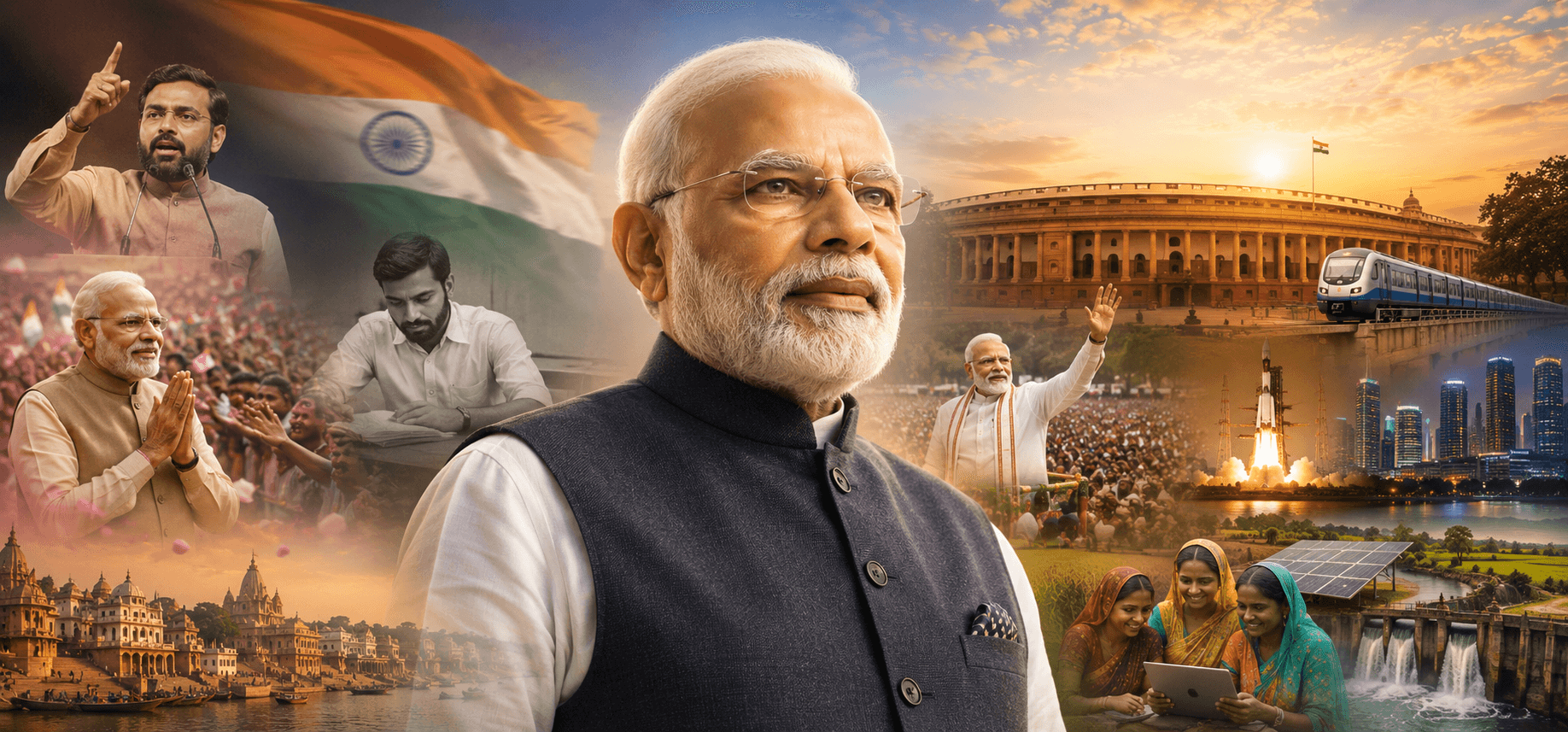
Excerpt: The Narendra Modi life story is a journey from a small railway town in Gujarat to the Prime Minister's Office in New Delhi. This simple, fact-based biography covers his education, political career, achievements, diplomacy, awards and leadership style.
Introduction: From Vadnagar to National Leadership
In the 1950s, Vadnagar was a small town in Gujarat, best known for its old temples and its railway station. A young boy from this town helped his father, who sold tea near the station. That boy was Narendra Modi. Decades later, he took the oath as the Prime Minister of India, one of the most important political positions in the world's largest democracy.
The Narendra Modi biography is not only the story of one person. It is also a window into modern Indian politics, grassroots organisation work, election campaigns, and governance. Students preparing for competitive exams, researchers, and general readers often study his life to understand how a worker from a political organisation rose step by step to national leadership.
This article explains his life journey in simple language: his early life, education, work with the RSS, entry into the BJP, years as Chief Minister of Gujarat, his terms as Prime Minister, his vision, diplomacy, awards, leadership style, and the criticism he has faced. The tone is neutral and factual, so readers can form their own views.
Basic Profile of Narendra Modi
Quick profile
Full Name | Narendra Damodardas Modi |
|---|---|
Date of Birth | 17 September 1950 |
Birthplace | Vadnagar, Mehsana district, Gujarat (then part of Bombay State), India |
Parents | Damodardas Mulchand Modi (father) and Heeraben Modi (mother) |
Education | Schooling in Vadnagar; Bachelor of Arts in Political Science (University of Delhi, distance education, 1978); Master of Arts in Political Science (Gujarat University, 1983) — as per publicly stated records |
Political Party | Bharatiya Janata Party (BJP) |
Major Positions | Chief Minister of Gujarat (2001–2014); Prime Minister of India (since 26 May 2014); Member of Parliament from Varanasi (since 2014) |
Early Life and Family Background
Narendra Modi was born on 17 September 1950 in Vadnagar, a small town in the Mehsana district of Gujarat. His family belonged to a modest background. His father, Damodardas Modi, ran a tea stall near the Vadnagar railway station, and his mother, Heeraben Modi, managed the household. Narendra was the third of six children.
Life at home was simple and money was limited. As a boy, Narendra helped his father serve tea at the railway station. This experience of early responsibility is often mentioned in his own speeches and in accounts of his life. Growing up in a small town, he saw everyday struggles of ordinary families from close range, which later became a common theme in his political communication.
Education Background
Narendra Modi completed his school education in Vadnagar. His teachers have described him as an average student in studies but very active in debates, drama, and public speaking.
According to publicly stated records, he later completed a Bachelor of Arts degree in Political Science through distance education from the University of Delhi in 1978, and a Master of Arts degree in Political Science from Gujarat University in 1983.
Note for publishers: his degree records have been a topic of public discussion in India. Before publishing, verify education details from official university statements and credible records, and avoid unsupported claims on either side.
Childhood and Formative Years
Several habits from Modi's childhood shaped his later life. He was interested in reading and spent time in the local library. He enjoyed acting in school plays and taking part in debates, which built his confidence in public speaking — a skill that later became one of his biggest political strengths.
He was also drawn to discipline and simple living from a young age. As a boy, he attended local branches (shakhas) of the Rashtriya Swayamsevak Sangh, where physical exercise, routine, and organisational values were taught. In his late teens, he left home and travelled across parts of India for about two years, visiting religious and spiritual centres. He has described this period as a time of self-discovery.
These formative years gave him three qualities that observers often highlight in his political life: discipline, comfort with hard routines, and the ability to connect with common people through simple language.
Journey with RSS
The Rashtriya Swayamsevak Sangh (RSS) is a large volunteer-based organisation in India that focuses on cultural and social activities. Narendra Modi's association with the RSS began in childhood in Vadnagar, when he started attending its local meetings.
In 1971, he became a full-time worker of the RSS, known as a pracharak. A pracharak dedicates his life to the organisation, travels widely, lives simply, and builds local units. Modi worked in Gujarat, organising activities, managing communication, and training volunteers. During the Emergency period (1975–1977), when many opposition activities were restricted, he worked underground, distributing literature and coordinating between activists.
This phase taught him organisation-building, networking, travel discipline, and ground-level political work. Many analysts see his RSS years as the foundation of his later election management skills.
Entry into BJP
In 1985, the RSS deputed Narendra Modi to the Bharatiya Janata Party (BJP), a national political party founded in 1980. In simple words, he moved from social-organisation work to direct political party work.
In the BJP, he quickly became known as a skilled organiser in Gujarat. In 1987–88 he was made an office-bearer of the Gujarat unit of the party, and he played a key role in planning election strategies in the state. He helped organise major political programmes, including L. K. Advani's Rath Yatra in 1990 (its Gujarat leg) and Murli Manohar Joshi's Ekta Yatra in 1991–92.
His organisational success in Gujarat took him to the national level. In 1995 he was appointed BJP national secretary, and in 1998 he became the party's general secretary (organisation), one of the most important internal posts, which he held until 2001. In these years he worked on party affairs in several states and built a wide political network.
Political Background
To understand Narendra Modi's political career, it helps to know the background in simple terms. The BJP grew rapidly in Indian politics during the late 1980s and 1990s. In Gujarat, the party formed governments in the 1990s, but the state unit saw internal disputes and frequent leadership changes. In 2001, after a devastating earthquake in Kutch and criticism of the state government's response, the party leadership decided on a change. Narendra Modi, till then an organisation man who had never held elected office, was chosen as the new Chief Minister of Gujarat.
Political Career Timeline
Key milestones
Year | Role or Event | Importance |
|---|---|---|
1950 | Born in Vadnagar, Gujarat | Humble small-town beginning of his life journey |
1971 | Became a full-time RSS pracharak | Start of lifelong organisational and public work |
1985 | Deputed to the BJP | Formal entry into party politics |
1995 | Appointed BJP national secretary | Recognition of his election management skills at the national level |
1998 | Became BJP general secretary (organisation) | One of the party's most powerful internal posts |
2001 | Sworn in as Chief Minister of Gujarat (7 October) | First elected office; start of nearly 13 years as CM |
2002, 2007, 2012 | Led BJP to victories in Gujarat assembly elections | Established him as a dominant state leader |
2013 | Named BJP's prime ministerial candidate | Became the national face of the party |
2014 | Sworn in as Prime Minister of India (26 May) | BJP won the first single-party majority in the Lok Sabha since 1984 |
2019 | Began second term as Prime Minister (30 May) | Returned with a larger mandate |
2024 | Began third consecutive term as Prime Minister (9 June) | First Indian PM since Jawaharlal Nehru to win three consecutive terms |
Chief Minister of Gujarat
Narendra Modi became the Chief Minister of Gujarat on 7 October 2001. He held the post for nearly 13 years, winning state elections in 2002, 2007, and 2012. This made him one of the longest-serving Chief Ministers of Gujarat.
As Chief Minister, he focused strongly on economic development, infrastructure, electricity supply, and attracting industrial investment. His government promoted initiatives such as the Vibrant Gujarat investor summits, improvements in rural electricity through the Jyotigram scheme, water management projects, and road and port development. The phrase "Gujarat model" became widely used in Indian political debate to describe his development-focused governance approach, although economists have debated its strengths and limitations.
His tenure also saw serious controversy. In 2002, communal riots broke out in Gujarat after the Godhra train burning incident, and more than a thousand people were killed, most of them from the Muslim community. His government faced strong criticism over its handling of the violence. A Special Investigation Team appointed under the Supreme Court's watch found no prosecutable evidence against him, and in 2022 the Supreme Court of India upheld that finding. The riots remain the most debated chapter of his career, and readers can study court records and credible reports for a fuller picture.
Journey to Prime Minister of India
By the early 2010s, Narendra Modi had become one of the most talked-about leaders in Indian politics. In 2013, the BJP made him the head of its national election campaign committee, and in September 2013 the party formally declared him its prime ministerial candidate for the 2014 general election.
The 2014 campaign was one of the largest in Indian history. Modi travelled across the country, addressed hundreds of rallies, and used technology such as 3D hologram speeches and social media on a scale not seen before in Indian elections. His campaign focused on development, governance, and change, with slogans promising "achhe din" (good days).
In the results, the BJP won 282 seats in the Lok Sabha — the first time since 1984 that a single party had won a clear majority on its own. Narendra Modi, who won the Varanasi seat, was sworn in as the 14th Prime Minister of India on 26 May 2014.
Prime Ministerial Career
Narendra Modi's time as Prime Minister can be understood in three phases. In his first term (2014–2019), his government focused on financial inclusion, sanitation, digital services, taxation reform, and foreign outreach. Major steps included the Jan Dhan bank account drive, the Swachh Bharat Mission, the Goods and Services Tax (GST) launched in 2017, and the demonetisation of high-value currency notes in November 2016, which remains a debated decision.
In the 2019 general election, the BJP returned with an even larger majority of 303 seats, and Modi began his second term on 30 May 2019. This term saw major and often debated decisions such as the removal of the special status of Jammu and Kashmir under Article 370 in August 2019, the Citizenship Amendment Act, the management of the COVID-19 pandemic including one of the world's largest vaccination drives, and India's G20 presidency in 2023.
In the 2024 general election, the BJP won 240 seats — short of a majority on its own — and Modi formed a government with the support of the National Democratic Alliance (NDA) coalition. He was sworn in for a third consecutive term on 9 June 2024, becoming the first Prime Minister since Jawaharlal Nehru to achieve this. His communication style throughout has been direct and personal, using his monthly radio programme Mann Ki Baat, large public rallies, and very active social media accounts.
Major Achievements of Narendra Modi
Here are some widely recognised achievements from his time in office, explained in simple language. Impact figures change over time, so exact numbers should be checked from official sources before publishing.
Financial inclusion at scale: The Jan Dhan Yojana brought hundreds of millions of unbanked Indians into the formal banking system, enabling direct transfer of government benefits into bank accounts.
Digital public infrastructure: Under the Digital India push, systems like Aadhaar-linked services and the UPI payment network grew rapidly, making India a global example of low-cost digital payments.
Tax reform: The Goods and Services Tax (GST), launched in July 2017, replaced many indirect taxes with one national system — one of India's biggest tax reforms since independence.
Sanitation and welfare delivery: The Swachh Bharat Mission built toilets across the country, while schemes like Ujjwala (cooking gas connections) and PM Awas Yojana (housing) targeted basic needs of poorer households.
Global positioning: India hosted the G20 presidency in 2023, expanded strategic partnerships, and saw milestones such as the Chandrayaan-3 Moon landing (2023) during his tenure, raising India's global profile.
Major Schemes and Initiatives
These flagship programmes are strongly linked to the Modi government. Each is described by its purpose and target group, without unverified statistics.
Swachh Bharat Mission: A nationwide cleanliness campaign focused on building toilets and ending open defecation.
Digital India: A programme to expand internet access, digital services, and online governance for citizens.
Make in India: An initiative to promote manufacturing in India and attract domestic and foreign investment.
Jan Dhan Yojana: A financial inclusion scheme to open zero-balance bank accounts for the poor.
Ujjwala Yojana: A scheme providing cooking gas (LPG) connections to women from low-income households.
Ayushman Bharat: A large public health insurance scheme covering hospital treatment costs for poorer families.
PM-KISAN: A direct income support scheme that transfers money to eligible farmers' bank accounts.
Startup India: A programme to encourage entrepreneurship through easier rules, funding support, and incentives.
Atmanirbhar Bharat: A self-reliance vision promoting domestic production, launched during the COVID-19 period.
PM Gati Shakti: A national master plan to coordinate infrastructure projects like roads, railways, and ports.
His Vision for India
Narendra Modi's vision for India, as expressed in his speeches and government documents, rests on a few clear themes. The central idea is "Viksit Bharat" — making India a developed nation by 2047, the hundredth year of independence.
Key themes include self-reliance in manufacturing and defence (Atmanirbhar Bharat), digital growth so that government services reach people directly, large-scale infrastructure such as highways, railways, airports and ports, a clean and green India through sanitation and renewable energy, support for startups and innovation, empowerment of youth and women, and a stronger voice for India in global affairs. He often describes this period as India's "Amrit Kaal" — a special window of opportunity for national growth.
Diplomacy and Foreign Policy
Narendra Modi's diplomacy is known for being personal, energetic, and highly visible. He invests time in one-to-one relationships with world leaders and travels frequently. His foreign policy approach can be understood through a few simple ideas.
First, "Neighbourhood First" — giving priority to relations with countries close to India, such as Nepal, Bhutan, Bangladesh, Sri Lanka, and the Maldives. Second, strategic partnerships — deepening ties with major powers like the United States, Japan, France, and Russia, and taking part in groupings such as the Quad, BRICS, and the SCO. Third, economic diplomacy — attracting investment, promoting trade, and marketing India as a manufacturing and technology destination. Fourth, diaspora outreach — connecting with Indian communities abroad through large public events. Fifth, positioning India as a voice of the Global South, which was a strong theme of India's G20 presidency in 2023.
He has also championed global initiatives launched or co-launched by India, such as the International Solar Alliance and International Yoga Day (21 June), recognised by the United Nations.
International Visits and Global Engagement
Narendra Modi is among the most widely travelled Indian Prime Ministers. Instead of listing every trip, it is more useful to group his foreign visits by purpose.
Neighbourhood diplomacy: Visits to Bhutan (his first foreign trip as PM in 2014), Nepal, Bangladesh, Sri Lanka, and the Maldives to strengthen regional ties.
Strategic partnerships: Repeated visits to the United States (including addresses to the US Congress), Japan, France, Russia, and Gulf countries like the UAE and Saudi Arabia.
Economic diplomacy: Trips focused on investment and trade, such as engagements with Germany, Australia, and the Gulf states, and participation in forums like the World Economic Forum.
Diaspora outreach: Large community events such as Madison Square Garden in New York (2014), Wembley Stadium in London (2015), and the "Howdy, Modi!" event in Houston (2019).
Global summits: Regular participation in the G20, G7 (as an invited guest), BRICS, SCO, COP climate summits, and United Nations sessions.
Note for publishers: the list of international visits keeps growing. Verify the latest visits from the Ministry of External Affairs and PMIndia.gov.in before publishing.
Innovations and Governance Style
Narendra Modi's governance style has several distinctive features. He communicates directly with citizens through his monthly radio programme Mann Ki Baat, social media, and the NaMo app, reducing dependence on traditional media. His government has pushed Direct Benefit Transfer (DBT), in which subsidies and welfare money go straight into bank accounts, reducing leakage through middlemen.
He is known for mission-mode campaigns — turning schemes into mass movements with clear names, targets, and public participation, such as Swachh Bharat and the COVID-19 vaccination drive with its CoWIN digital platform. Other features include monitoring big projects through the PRAGATI review platform, promoting "minimum government, maximum governance," using technology like the JAM trinity (Jan Dhan accounts, Aadhaar identity, and Mobile phones) for service delivery, and a strong personal work routine that colleagues describe as demanding.
Awards and Honours
Narendra Modi has received many top civilian honours from foreign governments, along with international recognitions from organisations. By 2026, he had received more than two dozen international civilian honours, one of the highest counts for any Indian leader. A selection of verified honours is given below.
Selected awards and honours
Year | Award or Honour | Country or Organization | Reason or Context |
|---|---|---|---|
2016 | Order of Abdulaziz Al Saud | Saudi Arabia | Highest honour for foreign dignitaries; strengthening bilateral ties |
2018 | Champions of the Earth Award | United Nations | Leadership on environment, including the International Solar Alliance |
2018 | Seoul Peace Prize | South Korea (Seoul Peace Prize Foundation) | Contribution to international cooperation and economic growth |
2019 | Order of Zayed | United Arab Emirates | Highest civilian award of the UAE; India–UAE relations |
2019 | Order of St Andrew | Russia | Russia's highest civilian honour; strategic partnership |
2020 | Legion of Merit | United States | Leadership in elevating the India–US strategic partnership |
2023 | Grand Cross of the Legion of Honour | France | France's highest honour; long-standing India–France partnership |
2023 | Order of the Nile | Egypt | Egypt's highest state honour; growing bilateral cooperation |
2024 | Order of the Druk Gyalpo | Bhutan | Bhutan's highest civilian award; first foreign head of government to receive it |
2025 | Grand Collar of the National Order of the Southern Cross | Brazil | Contribution to India–Brazil strategic relations |
Note for publishers: new honours continue to be conferred (including honours reported in 2025–2026 from countries such as Trinidad & Tobago, Ghana, Cyprus, and others). Verify the latest, complete list from official government sources before publishing.
Leadership Style
Narendra Modi's leadership style has some clear, widely observed features. He is a powerful communicator who speaks directly to large audiences in simple Hindi, uses memorable slogans and acronyms, and builds a personal connection with voters. He is a tireless campaigner, known for addressing a very large number of rallies during elections.
Administratively, he is described as centralised and detail-oriented, preferring direct monitoring of key projects through the Prime Minister's Office. He favours big, visible missions with fixed deadlines over slow incremental change. He also projects personal discipline — long working hours, yoga, and a simple personal lifestyle — as part of his public image. Supporters see this style as decisive and result-driven; critics argue it concentrates too much power in one office. Both views exist in public debate.
Challenges and Criticism
Every major public leader faces criticism, and a fair biography must mention it neutrally. Narendra Modi's career includes several debated chapters.
The 2002 Gujarat riots remain the most discussed. His government was criticised for its handling of the violence, though the Supreme Court-monitored investigation found no prosecutable evidence against him, a finding the Court upheld in 2022. The demonetisation of 2016 was praised by some as a strike against black money but criticised by many economists for its economic disruption. The Citizenship Amendment Act and the removal of Article 370 in 2019 were welcomed by supporters but triggered protests and legal challenges. The farm laws of 2020 led to large farmer protests and were eventually repealed in 2021.
Critics — including opposition parties, some scholars, and international organisations — have also raised concerns about press freedom, the treatment of minorities, and the use of investigative agencies during his tenure. His supporters reject these characterisations and point to electoral mandates, welfare delivery, and India's global standing. Readers should study court records, official data, and multiple credible sources to form a balanced view.
Key Lessons from Narendra Modi's Journey
Discipline compounds: Decades of routine, hard travel, and simple living built the stamina needed for national politics.
Communication is power: Clear, simple language and direct outreach to people can be as important as policy itself.
Long-term public work pays off: He spent nearly 30 years in organisational roles before holding any elected office.
Organisation before ambition: Mastering party structures, booth-level work, and election management created his path upward.
Leadership means owning decisions: Big, visible decisions bring both credit and criticism; a leader must be prepared for both.
Conclusion
The journey of Narendra Modi — from a tea seller's son in Vadnagar to a three-term Prime Minister of India — is one of the most remarkable political stories of modern India. His life shows how organisational work, discipline, and communication can carry a person from the margins of public life to its very centre.
His record includes major reforms, large welfare schemes, digital transformation, and a stronger global profile for India, alongside decisions and events that remain deeply debated. A balanced reading of the Narendra Modi biography requires looking at both the achievements and the criticism, with facts checked against official records. Whether one agrees or disagrees with his politics, his journey offers useful lessons in perseverance, organisation, and leadership for students and readers everywhere.
FAQs
1. Who is Narendra Modi?
Narendra Modi is an Indian politician and the Prime Minister of India since 26 May 2014. He belongs to the Bharatiya Janata Party (BJP) and earlier served as Chief Minister of Gujarat from 2001 to 2014.
2. Where was Narendra Modi born?
He was born on 17 September 1950 in Vadnagar, a small town in the Mehsana district of Gujarat, India.
3. What is Narendra Modi's education?
He completed his schooling in Vadnagar. As per publicly stated records, he holds a BA in Political Science from the University of Delhi (distance education, 1978) and an MA in Political Science from Gujarat University (1983). Publishers should verify details from official records.
4. When did Narendra Modi become Chief Minister of Gujarat?
He became Chief Minister of Gujarat on 7 October 2001 and served until May 2014, winning state elections in 2002, 2007, and 2012.
5. When did Narendra Modi become Prime Minister of India?
He was first sworn in as Prime Minister on 26 May 2014. He began a second term on 30 May 2019 and a third consecutive term on 9 June 2024.
6. What are Narendra Modi's major achievements?
Key achievements include large-scale financial inclusion through Jan Dhan Yojana, the GST tax reform, growth of digital payments and Digital India, sanitation and welfare schemes like Swachh Bharat and Ujjwala, and a stronger global role for India, including the G20 presidency in 2023.
7. What is Narendra Modi's vision for India?
His central vision is "Viksit Bharat" — a developed India by 2047 — built on self-reliance, digital growth, world-class infrastructure, clean energy, innovation, and empowerment of youth and women.
8. What is Narendra Modi known for internationally?
He is known for energetic personal diplomacy, large diaspora events abroad, strategic partnerships with major powers, the "Neighbourhood First" policy, promoting International Yoga Day and the International Solar Alliance, and positioning India as a voice of the Global South.
9. What awards has Narendra Modi received?
He has received top civilian honours from many countries, including Saudi Arabia, the UAE, Russia, the United States, France, Egypt, and Bhutan, as well as the UN Champions of the Earth Award and the Seoul Peace Prize. The full, latest list should be verified from official sources.
10. Does this biography need live fact-checking?
Yes. Awards, international visits, policies, government updates, and political positions can change, so live verification is required before publishing.
0 comments